Mass Timber and the Future of Kansas City
Highlights from a Recent AIA Panel
“Once the public and more people experience mass timber buildings and structures, more people will want it because they will see how beautiful it is. They will understand how the experience of walking through a mass timber building versus concrete or steel just feels better,” said David Penka, AIA, senior associate at DLR Group.
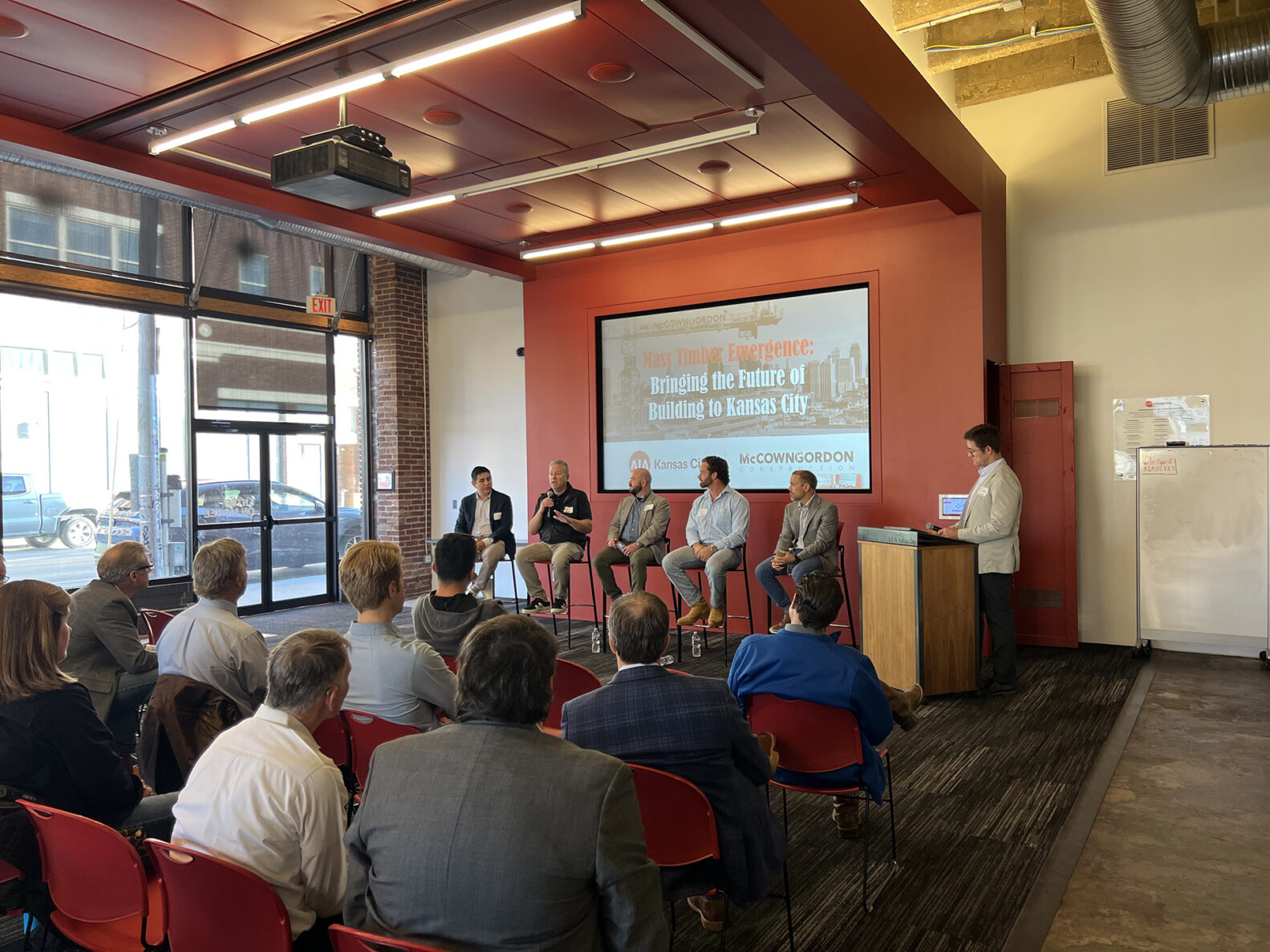
The Architecture, Engineering and Construction (A/E/C) industry continues to embrace sustainable innovation, and mass timber is emerging as the compelling alternative to traditional materials like concrete and steel. Industry experts gathered at a panel hosted by McCownGordon Construction to explore how the mass timber movement is beginning to take root in the Midwest and shared the secrets behind the product transforming the industry.
Driving Forces Behind the Mass Timber Movement
Mass timber is rapidly gaining traction across the United States, moving beyond its stronghold in the Pacific Northwest and into regions like the Midwest. It continues to gain signification traction in the industry as a sustainable alternative to conventional concrete or steel. Jaime Bustillos, project executive and one of the McCownGordon Mass Timber Experts noted the initial rise in popularity was driven by major U.S. cities adopting the material to support greener building practices. However, sustainability is not the only factor behind its growing appeal. Mass timber promotes sustainable design while offering biophilic and psychological benefits, cost-efficiency, faster construction and strong public support.
As observed by Houston Hunter, senior project manager at Mercer International, increased familiarity with mass timber is fostering greater confidence among industry professionals. Their ability to navigate the entire delivery process, from manufacturing to installation, has led to a notable rise in projects using the material. Owners are also starting to recognize the market differentiation mass timber offers. Penka emphasized for office buildings, student housing and mixed-use developments, mass timber helps projects stand out and lease faster. “It not only enhances aesthetics, but it also differentiates your structure in a crowded market,” Penka explained. Projects built with mass timber often attract tenants more quickly, and Penka observed some leasing at twice the pace of those constructed with traditional materials. “As more owners understand its value, mass timber will become a highly sought-after commodity,” he added. It’s not just owners recognizing mass timber’s appeal. Michael Burton, parks and rec project manager from the City of Overland Park explained during public visioning exercises, “mass timber wins hands down every time over steel and concrete,” with community members perceiving it as a higher-quality option.
Speed is also a major advantage of mass timber. Burton noted that on one project, “the contractor installed the roof in one day with a crane; with other materials, that’s seven to ten days.” Bustillos echoed Burton’s experience, adding mass timber not only accelerates construction but also improves scheduling and creates quieter job sites. “Compared to steel or concrete activities, the quietness was something I did not expect, and is a benefit, especially for construction near residential areas,” Bustillos said.
Mass Timber Misconceptions
Despite its growing popularity, mass timber still faces several misconceptions, which often deter its use in projects. One of the most persistent myths revolves around fire resistance. “The general public has a lot of misconceptions about mass timber and its fire resistance capabilities. But NFPA testing has helped address these concerns, leading code officials to approve taller mass timber buildings,” said Penka.
Another misconception is cost. Many assume mass timber carries a steep premium compared to concrete or steel. However, Bustillos explained cost should be evaluated holistically: “You must compare the project as a whole, taking in all the parts and pieces, and consider what you’re gaining from mass timber compared to other materials.” Exposed structural elements, reduce connections and faster construction timelines often offset initial premiums. On the City of Overland Park Farmer’s Market project, Paul Spears, president of Stand Structural Engineering shared the team partnered with a mass timber supplier early in the process. “They helped us work through the details and connections, so at the end of the day, the cost was spot on and there weren’t any surprises,” he said. Penka added that the speed of construction with mass timber can help offset any perceived premium, as faster delivery allows owners to occupy the building sooner and begin generating revenue.
Many panelists highlighted the lack of education within the community, as a major barrier to mass timber adoption. “A lot of times, mass timber is value engineered out of a project because of the unfamiliarity of it in the Kansas City area,” Spears explained. While usage is growing in municipal and collegiate projects, contractors who are unfamiliar with the material often dismiss it as too expensive. Spears emphasized education, accurate cost data and creative problem-solving are key to helping owners understand its value and encourage broader adoption.
Strategies to Make Mass Timber Project More Efficient
Panelists emphasized strategic planning is critical to the success of mass timber projects. One of the most effective strategies is early integration of key partners. “Because of innovation in our fast-paced industry, a big strategy to success is engaging with suppliers at the forefront of the project to understand what the product is capable of and how to optimize your structure to compete with steel,” said Penka.
From the owner’s perspective, Burton highlighted the importance of choosing a great partner and site planning for long term success. He explained how proper orientation of the structure has helped the City of Overland Park mitigate damage from environmental factors such as rain, solar exposure and wind.
Moisture mitigation is a critical factor in mass timber construction. Bustillos emphasized, “One of the most important things you can do before construction begins is develop a moisture mitigation plan; it is crucial to the success of the project.” Proper sequencing of construction activities to achieve a weather-tight building as quickly as possible is essential. Without this, heavy rain can trap moisture between the concrete topping slab and the mass timber deck, creating a costly and challenging problem to resolve. Hunter reinforced this point, noting, “Mass timber is designed to handle water, but standing water is the number one enemy. Standing water will lead into cosmetic issues, which will slowly evolve into structural issues.” He emphasized one of the most critical nuances with mass timber is to develop a comprehensive moisture mitigation plan.
Education and preparation can overcome hesitation around mass timber. As Bustillos concluded, “A lot of people tend to shy away from mass timber because they’re unfamiliar with it, but if you have a plan in place, that goes a long way.”
How Mass Timber Will Continue to Be Adopted
Mass timber’s growth in the industry will continue to be driven by early advocacy and hands-on experiences. When owners are introduced to the material at the start of a project, integration into design and budgeting becomes much easier, the panelists explained.
The panelists agreed that momentum is building. As markets like the Midwest become more sophisticated, education among A/E/C professionals is accelerating—further fueling adoption. In the coming years, expect more projects to embrace mass timber thanks to its proven ability to deliver superior results for owners, end users and the environment.
Learn more about considerations when constructing a mass timber project
Panel:
- David Penka, AIA, Senior Associate, DLR Group
- Paul Spears, President, Stand Structural Engineering
- Jaime Bustillos, Project Executive, McCownGordon Construction
- Houston Hunter, Mercer International, Senior Project Manager
- Michael Burton, City of Overland Park, Park & Rec Project Manager
- Jason Bahr, PE, Regional Director, Woodworks (Moderator)